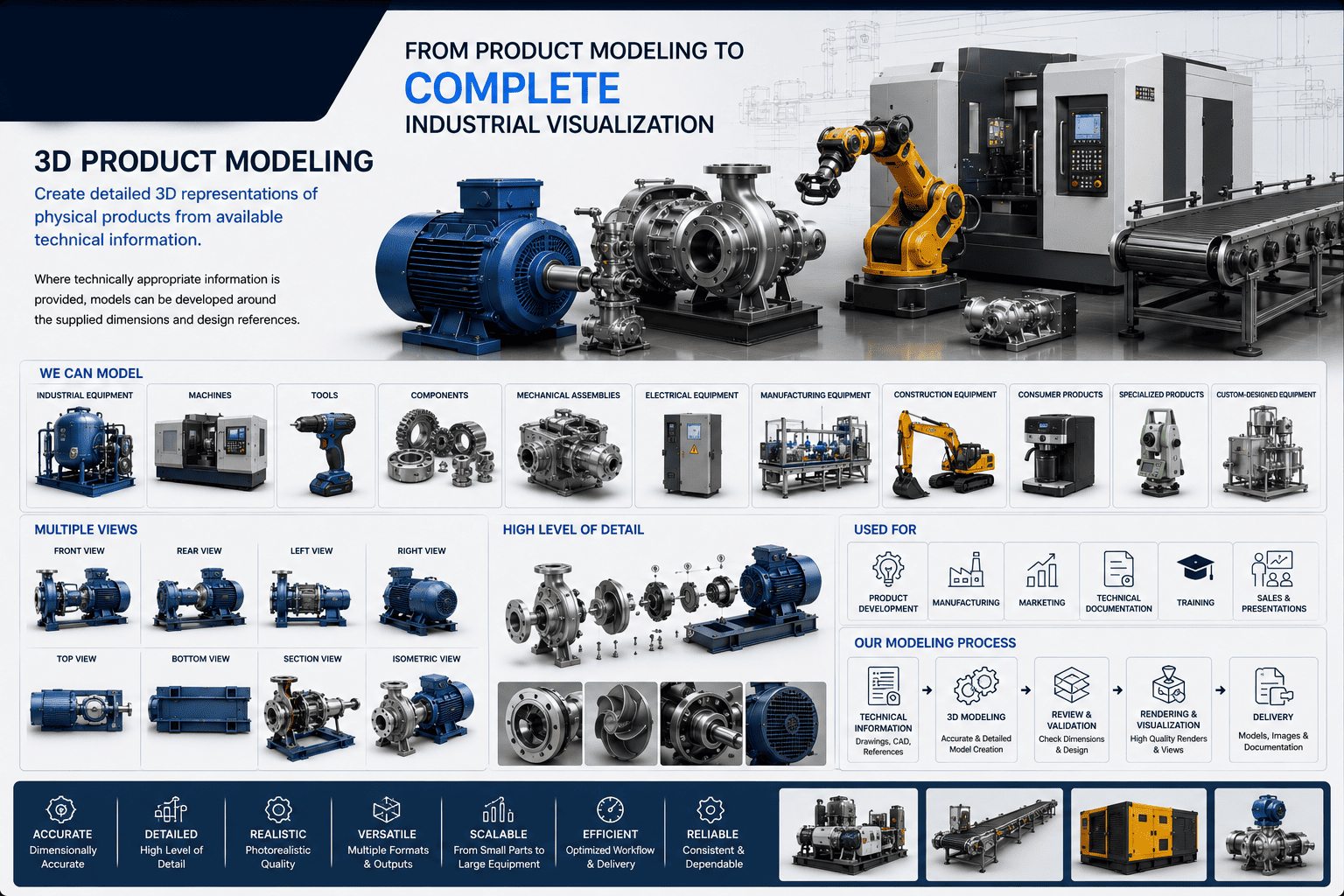
3D Product Modeling
Create detailed 3D representations of physical products from available technical information.
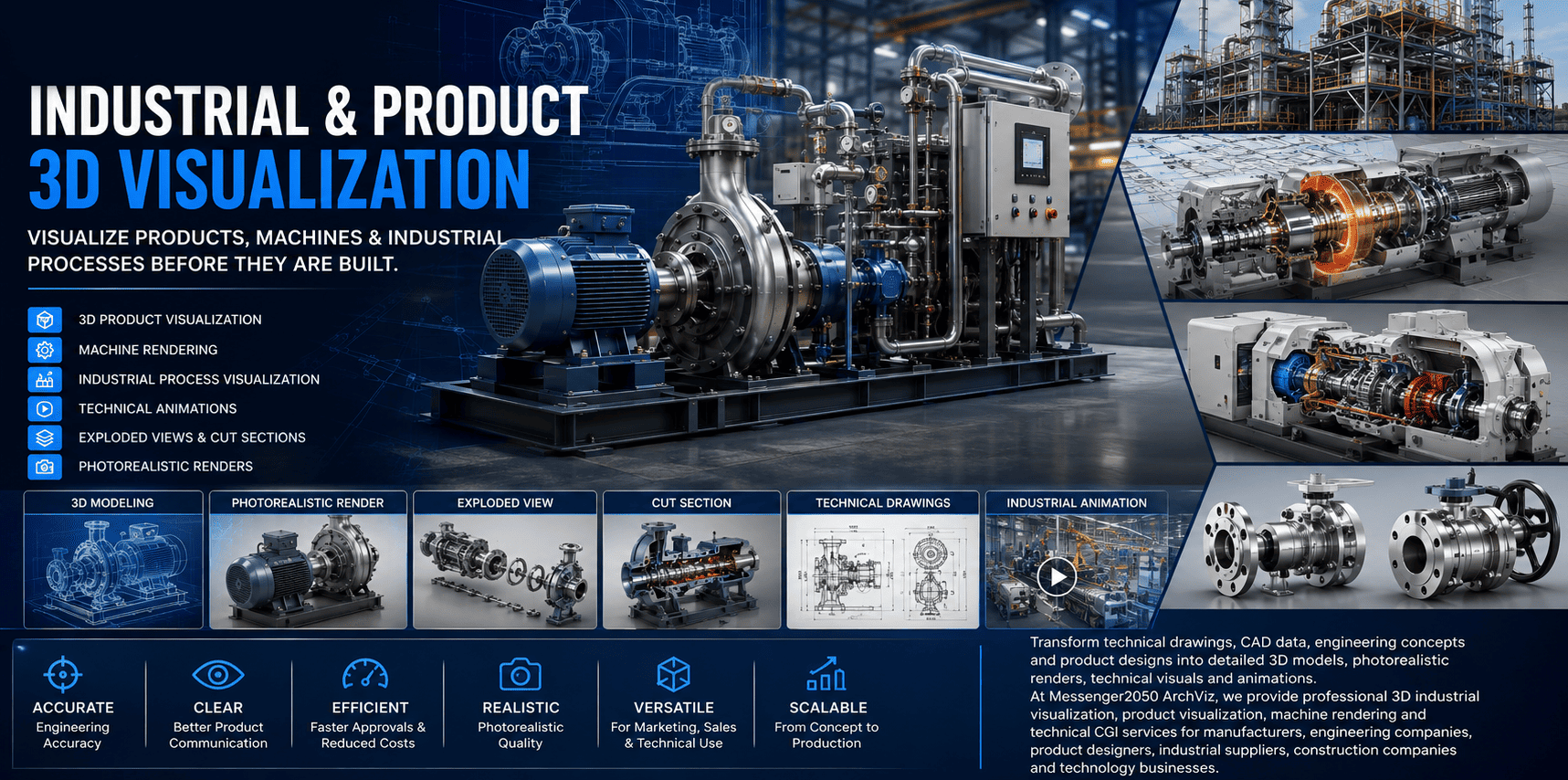
Transform technical drawings, CAD data, engineering concepts and product designs into detailed 3D models, photorealistic renders, technical visuals and animations.
At Messenger2050 ArchViz, we provide professional 3D industrial visualization, product visualization, machine rendering and technical CGI services for manufacturers, engineering companies, product designers, industrial suppliers, construction companies and technology businesses — turning technical information into clear, visually compelling 3D content.
From a single industrial component to a complete machine, production system or manufacturing process, our 3D visualization workflow can turn complex technical information into visuals suitable for engineering presentations, product marketing, technical documentation, sales presentations, websites, catalogs, training and animation.
Industrial products and machinery are often difficult to explain through technical drawings alone.
A 3D visualization can show the same product from multiple perspectives while making its easier to understand its shape, structure, components, materials, assembly, function, scale, operation, and internal mechanisms.
We can develop visual content from CAD, engineering drawings, technical specifications, sketches and product references into a 3D model, materials, lighting, product rendering, technical visualization, and animation.
Create detailed 3D representations of physical products from available technical information.
Create detailed 3D representations of machinery and equipment.
Create presentation-ready 3D models for products at different stages of development.
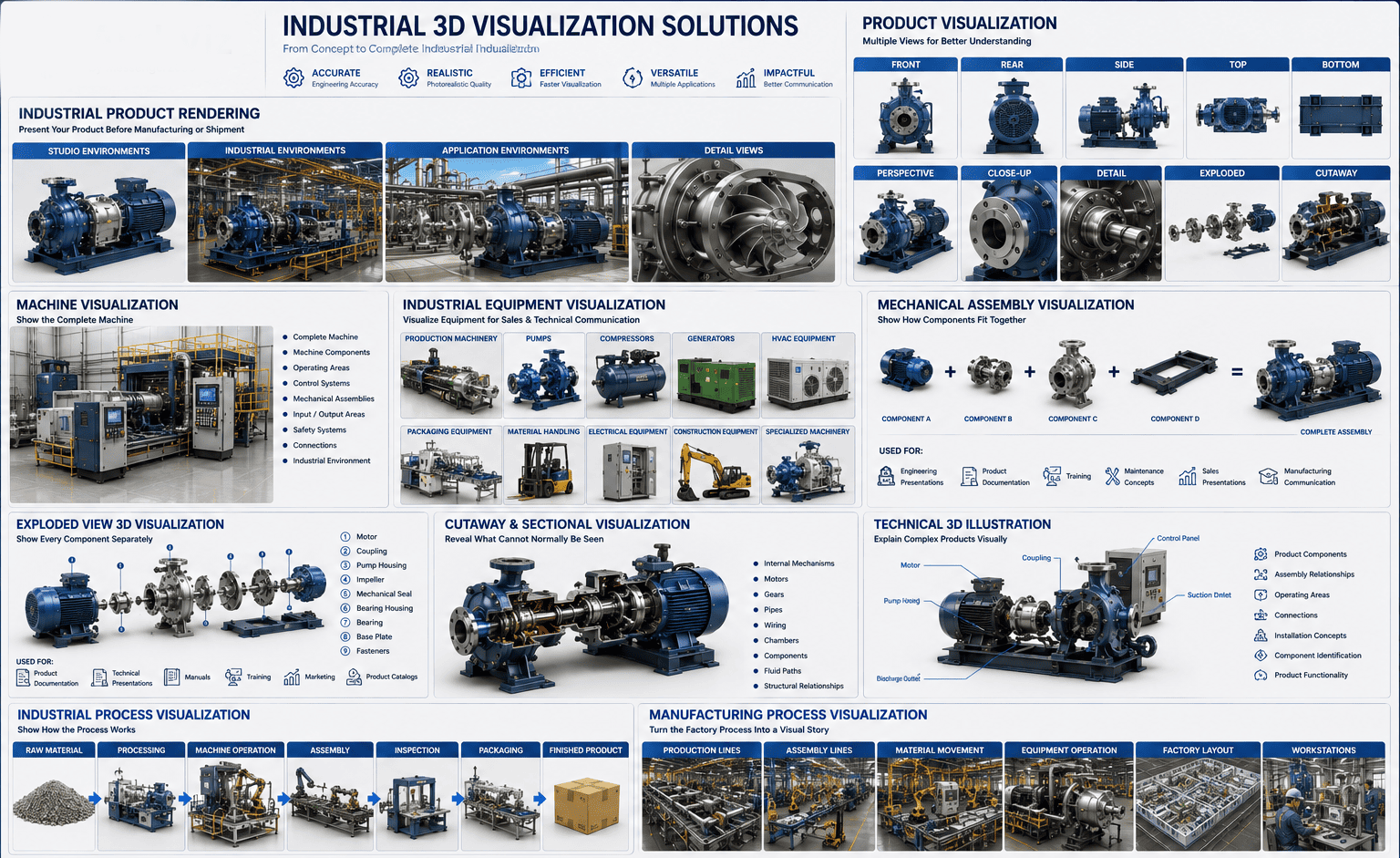
Photorealistic industrial renders can present products in:
Clean product-focused backgrounds suitable for catalogs, websites and presentations.
Place the product inside a realistic factory, warehouse, workshop or production environment.
Show the product being used in its intended environment.
Focus on important components, interfaces, materials and design features.
Make the Product Easy to Understand.
We can create multiple views of a product including:
This provides flexibility for product presentations and marketing materials.
Show the Complete Machine.
Large machinery can be difficult to photograph or explain before installation.
3D visualization can present:
This can be particularly useful for manufacturers selling specialized equipment.
Visualize Equipment for Sales & Technical Communication.
We can visualize:
The exact scope depends on the available engineering information.
Complex assemblies can be difficult to understand from individual technical drawings.
3D visualization can show component A, component B, component C, and component D becoming a complete assembly.
This can be used for:
Show Every Component Separately.
Exploded views separate components visually while maintaining their relationship to the complete assembly.
They can show:
Exploded views can be useful for:
Reveal What Cannot Normally Be Seen.
Some products and machines contain important components inside their exterior housing.
A cutaway visualization can reveal:
This provides a visual explanation without requiring the physical product to be opened.
Explain Complex Products Visually.
Technical 3D illustrations combine accurate product representation with clear visual communication.
They can be used to show:
These visuals can complement conventional technical drawings.
Show How the Process Works.
Industrial operations can involve many interconnected machines, stages and movements.
We can create 3D process visualization showing a conceptual sequence such as:
This can help non-technical audiences understand complex industrial processes more easily.
Turn the Factory Process Into a Visual Story.
We can visualize selected manufacturing workflows including:
The final visualization can be presented through still images, diagrams or animation.
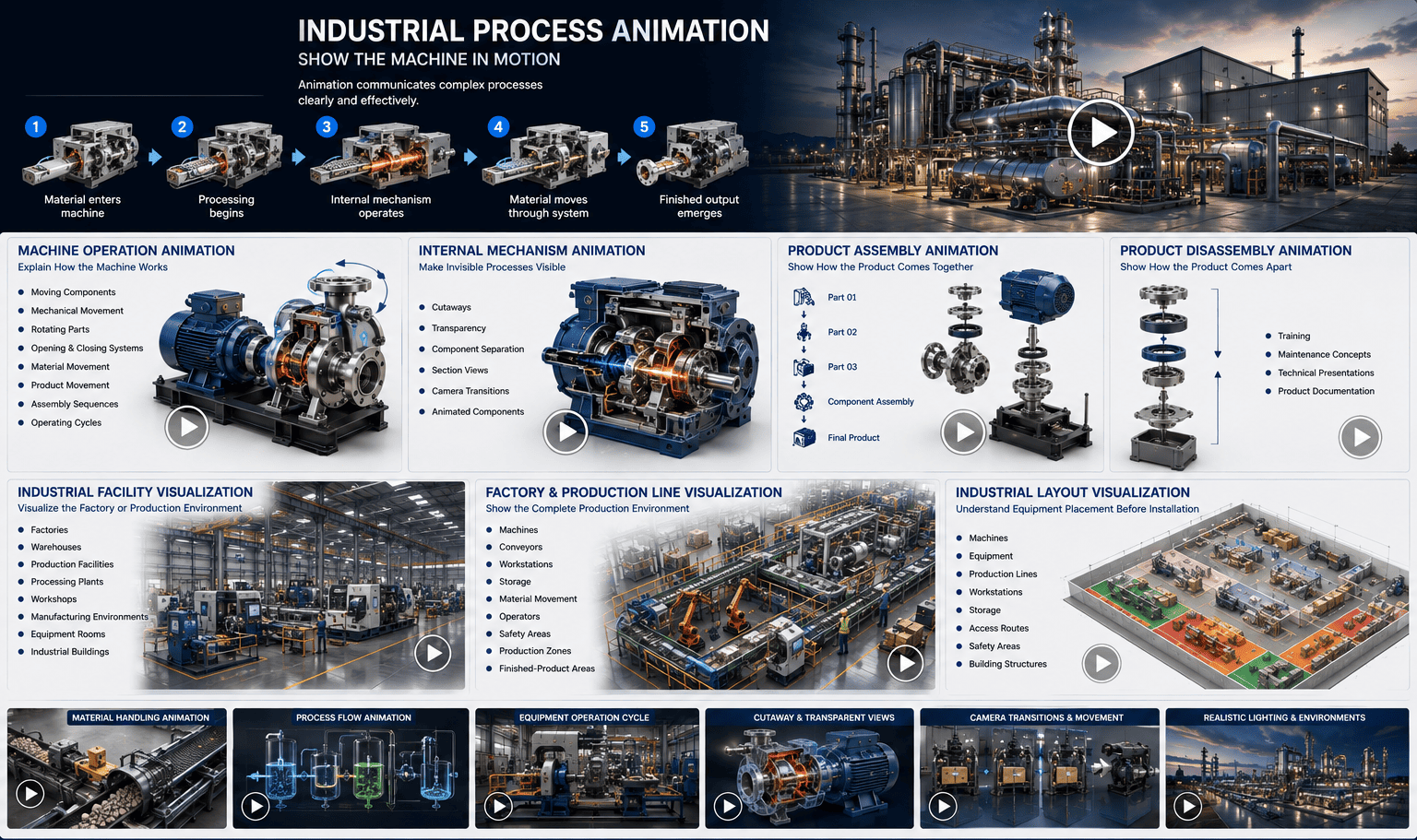
Show the Machine in Motion.
Animation can communicate processes that are difficult to explain through still imagery.
For example:
This can be especially useful for complex machinery and industrial systems.
Explain How the Machine Works.
A machine animation can demonstrate:
The animation can focus on the overall machine or specific mechanisms.
Make Invisible Processes Visible.
Some of the most important parts of a machine cannot be seen during normal operation.
We can use:
to visually explain internal operation.
Show How the Product Comes Together.
Assembly animation can demonstrate:
This can support:
Show How the Product Comes Apart.
Where appropriate, animation can demonstrate the conceptual sequence of removing components from an assembly.
This can be useful for:
The sequence should be based on the supplied product information and intended use.
Visualize the Factory or Production Environment.
We can visualize industrial facilities including:
The visualization can include machinery, equipment, production areas, storage and relevant environmental elements.
Show the Complete Production Environment.
For production-line projects, visualization can present:
This can provide a clear visual overview of the proposed or existing production environment.
Understand Equipment Placement Before Installation.
3D industrial layout visualization can help communicate the spatial relationship between:
This can be particularly useful for presentations and conceptual planning.
Turn Technical Products Into Marketing Content.
Industrial products often need more than a technical specification sheet.
We can create marketing visuals for:
A single 3D product model can support multiple marketing outputs.
Build Consistent Visuals Across Your Product Range.
For companies with multiple products, we can develop a consistent visual system.
For example:
Each product can be presented using a consistent:
This creates a more professional product catalog.
Alongside 3D visualization, we can help create professional product datasheets / technical data sheets / product specification sheets using the appropriate information supplied by the client.
High-quality 3D product render.
Clear product identification.
Short description of the product and its intended application.
Important product characteristics.
Information such as:
Dimensioned visual or technical representation where required.
Important components or included elements.
Typical uses or industries.
Company and product contact information.
Technical specifications can include dimensions, weight, capacity, power, materials, performance specifications, operating parameters, connections, and other client-supplied technical data.
Different Documents Serve Different Purposes.
Primarily communicates:
What the product is + key specifications + applications + visual presentation.
Primarily communicates:
Dimensions + geometry + technical details + engineering information.
Combines:
Product Visual + Features + Applications + Selected Specifications.
We can help create the visual presentation layer around client-supplied technical information.
Show Dimensions More Clearly.
Products can be presented with visual dimension indicators showing selected:
This can help customers understand the physical size of the product.
Show Different Product Versions.
For products available in multiple configurations, we can visualize:
This can help reduce the need for separate physical photography for every configuration.
Instead of presenting equipment against a plain background, the product can be shown within an appropriate environment.
For example:
This helps communicate the practical application of the product.
3D visuals can support training content by showing:
These visuals can be incorporated into training videos or digital learning materials.
You can provide DWG, DXF, Step / STP, Iges / IGS, or other CAD files.
Where an existing 3D model is not available, we can also work from engineering drawings, technical drawings, product photographs, product sketches, dimensions, product specifications, assembly diagrams, reference videos, existing manuals, and process diagrams. The exact formats and level of reconstruction depend on the project and available files.
Understanding the Requirement
We establish product or machine type, intended use, required visual outputs, target audience, technical complexity, required views, required animation, and delivery requirements.
Reviewing What You Provide
We review available CAD, drawings, specifications, references, and existing models, to understand the available information.
Preparing the Model for Visualization
We create, clean, optimize or prepare the 3D model. Depending on the project, this can include geometry, components, assemblies, materials, moving parts, and environment.
Developing the Surface Language
We establish the appearance of metal, plastic, glass, rubber, paint, steel, aluminum, composite materials, and other supplied material references.
Placing the Product in Context
Where required, we place the product in a studio, factory, workshop, warehouse, construction environment, or application environment.
Choosing How the Product Is Seen
We establish appropriate lighting, perspective, camera angles, product composition, and detail views.
Explaining the Product Clearly
Where required, we create exploded views, cutaways, section views, dimension visuals, component callouts, and process illustrations.
Planning the Sequence
For animated projects, we establish sequence, component movement, camera movement, process stages, assembly / disassembly, and product operation.
Reviewing Before Final Production
A preview is provided for review. Technical and visual feedback can be incorporated according to the agreed scope.
Producing the Delivered Assets
Final still images or animations are produced at the required quality.
Preparing Content for Every Channel
Where included, approved visuals can be incorporated into product sheets, datasheets, catalogs, brochures, presentations, and website content.
Presentation-ready 3D model based on supplied information.
High-resolution product imagery.
Product shown within its intended environment.
Separated component visualization.
Internal component visualization.
Clear visual explanations of product components and functions.
Industrial process representation.
Animated product operation and presentation.
Machine movement and operating sequences.
Professionally designed product / technical data presentation using client-approved information.
Consistent visual content across product ranges.
Present products, machines and equipment before or alongside physical production.
Explain equipment, systems and industrial processes.
Communicate complex technical concepts visually.
Present machine design, operation and components.
Visualize products before manufacturing.
Present machinery and equipment in realistic application environments.
Explain hardware and physical technology products.
Create product imagery, catalogs and sales presentations.
Visualize production systems and industrial facilities.
Develop industrial CGI assets for their clients.
Depending on project requirements, our services can support products and equipment associated with:
The specific technical scope depends on the supplied project information.
This can also include manufacturing, construction, engineering, automotive, industrial machinery, energy, electronics, and electrical equipment.
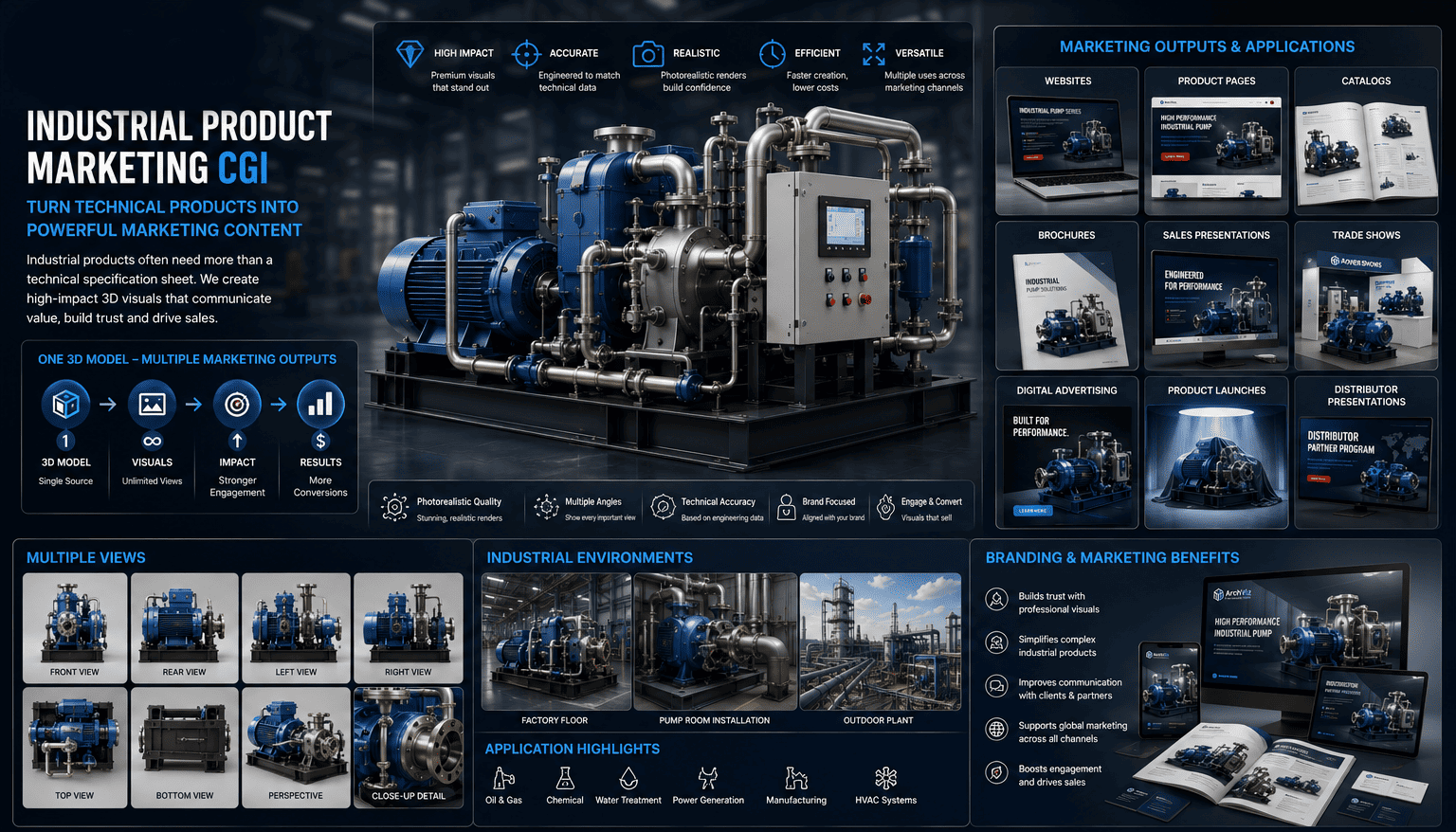
We work from technical drawings and product information to create understandable visual representations.
A single approved product model can support:
Our broader visualization capability allows us to work across products, machinery, buildings and environments.
Visuals can be created for both marketing and technical presentation purposes.
Products and machines can be presented in motion rather than only as static images.
ArchViz is part of Messenger2050 Technologies, combining 3D visualization with animation, software and digital production capabilities.
A single approved product model can support a render, exploded view, cutaway, animation, datasheet, and catalog.
One product model can become the foundation for an entire visual communication system.
Whether you have a CAD model, engineering drawing, machine design, product sketch, existing product or industrial process, send us your available information.
We'll review the available information and recommend the appropriate 3D modeling, rendering, technical visualization or animation approach.
Equipment, machinery and consumer products visualized from CAD and technical data.